Sales and revenue
Explore future sales patterns to inform targets, budgets and commercial planning.

Forecast sales, anticipate churn and uncover opportunities with an AI agent that helps you analyse data, train models and put predictions to work. All inside your Snowflake account.
Turn historical performance and relevant business signals into forward-looking forecasts that help your teams plan demand, revenue, inventory and capacity with greater clarity.
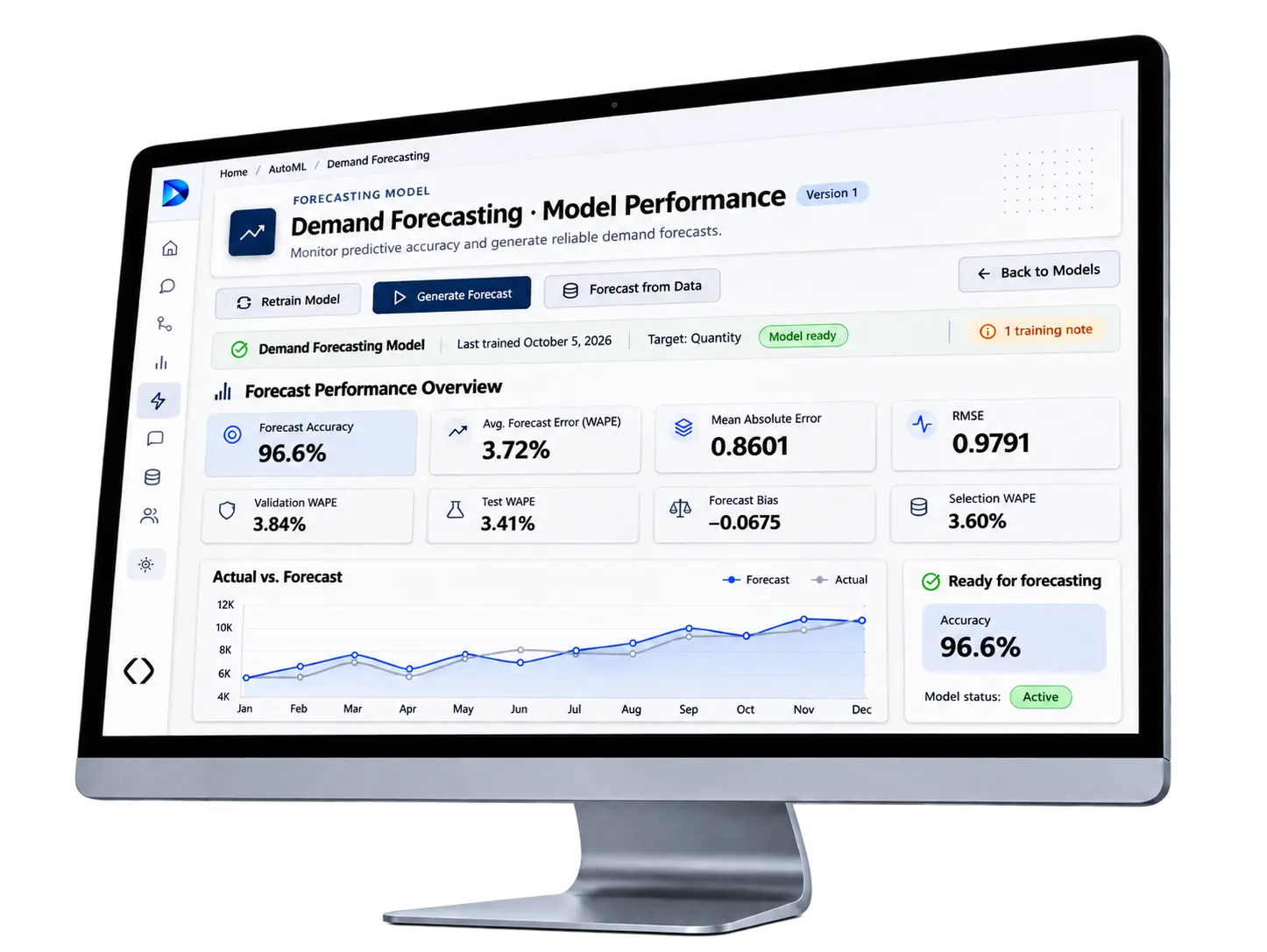
Give commercial, finance and operations teams a clearer view of future demand and the trade-offs behind their next decision.
Explore future sales patterns to inform targets, budgets and commercial planning.
Anticipate changes in product demand to support purchasing, allocation and stock planning.
Understand likely workload fluctuations and plan resources around expected demand.
Use forward-looking estimates to shape budgets, compare scenarios and review assumptions.
Structure the forecasting journey around the decisions your business needs to make, not a complicated technical process.
Choose what to forecast and how far ahead you need to plan.
Identify relevant history, business context and available inputs.
Assess historical patterns and develop a forward-looking estimate.
Understand assumptions, uncertainty and alternative outcomes.
Use the outlook to plan, then revisit it as conditions change.
Review relevant historical trends, assumptions and potential scenarios before making a plan.
Bring forecasting closer to the people making the decision. Frame the question in business language, explore possible outcomes and connect the outlook to practical next steps.
Frame each forecast around business context, possible change and the next decision your team needs to make.
Explore patterns across time to inform future planning.
Align the outlook with weekly, monthly or quarterly decisions.
Consider how different assumptions could change the plan.
Keep key drivers, caveats and decisions connected to the forecast.
Turn projected demand or performance into a discussion about budgets, capacity, purchasing and priorities.
Make forecasts more useful by reviewing their inputs, limitations and relevance to the decision at hand.
Check that the history and business measures fit the question being asked.
Make planning assumptions explicit so stakeholders can challenge them.
Use forecasts as estimates, not guaranteed outcomes.
Revisit the outlook as new results and market conditions emerge.
Bring the forecast, the key assumptions and the planning response into one business conversation.
Illustrative decision framework; not a live product output.
Key questions to consider when introducing AI-assisted forecasting to business planning.
Relevant applications can include demand, sales, revenue, inventory and capacity planning. The appropriate use case depends on your business data and decision process.
It depends on the time horizon, seasonality, volatility and available business drivers. The first step is assessing whether your available data supports a meaningful forecast.
Scenario analysis can help teams consider different assumptions. The specific data inputs and scenario capabilities should be agreed during solution scoping.
No. Forecasts are estimates subject to uncertainty. Quality depends on the data, forecasting method and changing market conditions.
No. This page presents the standalone VDD.ai Forecasting Agent offering. Dravity Auto ML is a separate product capability.
Explore how a forecasting solution could support your planning priorities, from demand and revenue to inventory and capacity.
An architect has your note and will follow up shortly.
Prefer to pick a time now? Book a slot with an architect